
Test post to see what happens
Library Consulting
Test post to see what happens

I’m using this for my Reread an Old Favorite square on my book bingo.
Oh Mrs. Frankweiler and your mixed-up files, how I love you.
Oh dear Claudia and your elaborate planning, dear Jamie and your pockets full of change, how I love you.
Oh dear Metropolitan Museum of Art and your antique beds on which children can apparently sleep while the hide out away from home, how I love you.
There is so much in this book that I aspired to the first 80 times I read it. I don’t know that I can give much of a clear-sighted review, but I shall try. As all oldest sisters do, Claudia grows weary of her boring suburban life and her utterly unfair share of household chores, so she decides to run away. But, being unable to give up her creature comforts as all oldest sisters are, she decides to run away to the Metropolitan Museum of Art in New York City. (Oh how she would scold me for the phrase “run away to!”) Jamie, being a gambling man with an inclination to stinginess and the only of her three younger brothers she can stand, gets the privilege of acting as financier and accompaniment.
Once at the museum, they stash their bags and take up residence as permanent students during the day, stowaways at shift change, and tenants in the evening. But a mystery unfolds when Claudia falls in love with a statue which may or may not have been created by the great Michelangelo himself. The duo commits their brief freedom to finding the truth and eventually their research takes them to the keeper of it, the elusive Mrs. Basil E. Frankweiler.
Look, I love this book so much, but I can admit there’s something wrong with it: the illustrations. I know, I know, publishing was a different world back in the 60s, especially publishing for kids. “Young Adult” wasn’t even a genre then. Kids read kids’ books until their teen years and then they read adult classics. The publishing house probably only accepted her manuscript because she had illustrations to convince them it was a children’s book. But E. L. Konigsburg, my girl, these illustrations are not good. They are not. In fact they are bad. I will go that far.
But there’s also so much to love! Claudia is fiercely independent, and she loves having secrets, and she loves feeling like an adult. I think more than feeling like an adult, she loves feeling like adults respect her. There’s only a couple of times this happens in the book, but they are her shining moments. That’s probably why I loved it so much as a kid (besides the fact that she got to run away and live independently in a museum, because of course that was my dream too).
This is a great story, and now that we’re 50 years past the time period of the book it’s sort of a look back. I know it wasn’t intended as historical fiction but this is probably the best view of the 60s I’ve ever gotten in a book. Honestly, if you didn’t read this as a kid I bet it won’t be stellar as an adult. But if you have kids, please please read them this book. It’s one of those stories that set my imagination on fire. I bet it will do the same for them.

I’m using this for my Coming to the Big Screen square on my book bingo.
In this illustrated novel, Conor accidentally conjurs an enormous monster with a penchant for storytelling to defend him against a larger, more dangerous monster.
Cancer. The larger, more dangerous monster is cancer. I promise this doesn’t ruin the story for you. You’d figure it out within the first chapter anyway. I was a little bummed at first, since the real monster being the threat of losing a loved one to disease felt a little cliche. But I’m glad I stuck it out, because WOW was that ever satisfying.
You’ll notice I call this an illustrated novel rather than a graphic novel. I think the distinction is important, because while a graphic novel is like a more developed, long-form comic book, this is really a prose story interspersed with illustrations a la Brian Selznik’s The Invention of Hugo Cabret. Jim Kay’s work with these illustrations is flawless, relying heavily on shadow to control focus and tone. I also appreciate that the artwork doesn’t just complement the text; it’s a vital part of the story itself. It provides the sense of movement Patrick Ness’s straightforward tone sometimes lacks, and there’s plenty of darkness to communicate Conor’s mental state.
One aspect of Ness’s prose I really appreciated was his focus on physical happenings instead of inner thoughts. It’s a textbook example of showing, not telling. If this is something you’re working on in your own writing (most of us are), A Monster Calls makes for a masterful tutorial. Every inch of heartbreak is shown, not described, and that makes it hurt so much worse.
And boy howdy is there ever heartbreak. I mean, here’s a kid who’s being haunted by a monster and isn’t even scared because his mom is dying of cancer and that’s way scarier. The theme isn’t that cancer is a scary monster like I worried it would be; it’s really about selfishness and letting go. There’s so much heart and so much bleakness that I nearly cried THREE SEPARATE TIMES on the bus.
Of course, it doesn’t come without its weaknesses. Sadly, the nightmares didn’t quite feel nightmarish. Maybe it’s because the illustrations are the biggest source of darkness in this book, but you can take them in square inch by square inch instead of in one big overwhelming gulp. But holy crap, this movie will be terrifying.
Anyway, watch the movie for scares (probably), read the book for tears (definitely).
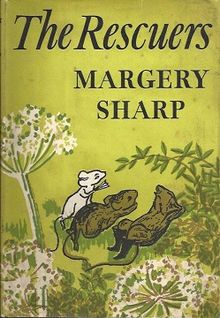
I’m using this for my Classic You’ve Never Read square on my book bingo.
Yes, this is the source material for the beloved children’s animated classic Disney’s The Rescuers (1977). However, there is nothing to love about the better-off-forgotten 1959 book.
Here’s the deal: my review is going to have a lot of spoilers because you DEFINITELY don’t want to read this book. I have done the reading for you. Please do not.
The Prisoner’s Aid Society of Mice decides that, breaking all protocol and precedent, they must rescue a poet from a terrible dungeon. Bernard is volunteered to recruit Bianca (the Ambassador’s son’s pet mouse) to recruit a Norwegian mouse, all with the goal of communicating with this poet. Turns out by “Norwegians” Margery Sharp actually means “pirates.” Bianca faints twice in Norway because she was written in 1959 and she’s female so why wouldn’t she faint, really? The recruitment process and the voyage back takes just under half the book for no good reason.
Eventually, Norwegian pirate mouse Nils sets off for the dungeon with reluctant Bernard and lovestruck Bianca in tow. Once there, they infiltrate the prison and make themselves comfortable in the wall of the warden’s office. Another almost half of the entire book is spent on their living arrangements: how they use stamps to make carpeting, how they carefully hang cardboard so delicate Miss Bianca is safe from the rough, rowdy men, and how silly sheltered Miss Bianca doesn’t believe the cat is mean because she’s only met nice, cultured cats.
The cat is clearly the main antagonist in the book, but the mice never actually defeat him. Their answer whenever he puts them in danger is just wait until he falls asleep. So exciting. In fact, that’s even the grand plan to rescue the prisoner. Wait until everyone falls asleep.
What little is left in the book contains an anticlimactic rescue where the mice do nothing but throw the keys to the poet-prisoner. The poet, by the way, never proves his innocence or gives any reason he should not be in prison. It’s just that he’s a poet, so obviously he’s also an angel with too weak a constitution for this terrible place and must be rescued. The mice are rewarded with medals after this heroic venture and everyone goes their separate ways.
Ask me if Bianca and Bernard’s flirtation ever blossoms into romance. Go ahead. Ask me!
No. No it doesn’t. When they finally address their feelings on the third to last page, a human spots Bianca and scoops her up. “Ah,” he says, “the Ambassador’s son’s pet mouse!” And off he walks.
“It was never meant to be!” Bianca calls to Bernard as she is carried away. That’s it. That’s the end of the romance.
But of course my favorite line comes when Bernard and Nils try to protect Miss Bianca from danger as they have been doing the whole book. “Oh sweet Bernard, strong Nils,” Bianca says. “I may not be clever or courageous like you men, but at least let me use my charm!”
Maybe in 1957 this was a good book, but there are better books out there now. Do not read this. Please, if you love yourself, do not read this book. The Rescuers is unimaginative, slow-moving, and old-school sexist. The movie is way better and it has crocodiles and diamonds. Please do not read this book.

I’m using this for my LOL worthy square on my book bingo.
After two hyenas witness a newlywed couple be devoured while on safari, they decide being a person sounds like fun, and they’ve picked up a fair amount of English listening to tourists all these years, so why not? They quickly dress in the newly vacant clothes and POOF they’re taken for humans.
What a fun premise! And what a disappointment. The story arc didn’t quite feel finished, and there were all sorts of opportunities built right into the plot for the author to heighten the stakes but Clary just let them slip through his fingers. (view spoiler) It’s like the whole book was a lead up to a story that never happened.
I have to admit something here: I wasn’t sure whether this was a YA book or an adult book. When I later explained to someone that it’s a book about hyenas who impersonate humans and live in a little house in London with their two pup children, I was viciously mocked for not realizing instantly it’s intended for young readers, like second and third grade. Perhaps I would have liked it better if it had been written for an older audience like I was expecting. Oh well.

 Liz Gabbitas