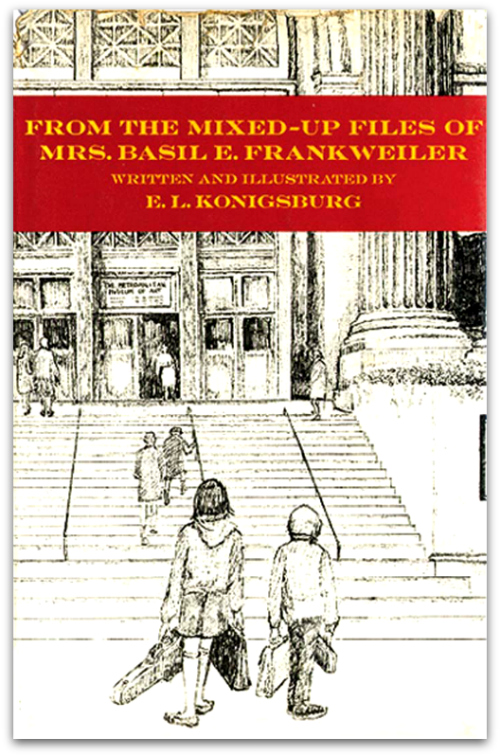
I’m using this for my Reread an Old Favorite square on my book bingo.
Oh Mrs. Frankweiler and your mixed-up files, how I love you.
Oh dear Claudia and your elaborate planning, dear Jamie and your pockets full of change, how I love you.
Oh dear Metropolitan Museum of Art and your antique beds on which children can apparently sleep while the hide out away from home, how I love you.
There is so much in this book that I aspired to the first 80 times I read it. I don’t know that I can give much of a clear-sighted review, but I shall try. As all oldest sisters do, Claudia grows weary of her boring suburban life and her utterly unfair share of household chores, so she decides to run away. But, being unable to give up her creature comforts as all oldest sisters are, she decides to run away to the Metropolitan Museum of Art in New York City. (Oh how she would scold me for the phrase “run away to!”) Jamie, being a gambling man with an inclination to stinginess and the only of her three younger brothers she can stand, gets the privilege of acting as financier and accompaniment.
Once at the museum, they stash their bags and take up residence as permanent students during the day, stowaways at shift change, and tenants in the evening. But a mystery unfolds when Claudia falls in love with a statue which may or may not have been created by the great Michelangelo himself. The duo commits their brief freedom to finding the truth and eventually their research takes them to the keeper of it, the elusive Mrs. Basil E. Frankweiler.
Look, I love this book so much, but I can admit there’s something wrong with it: the illustrations. I know, I know, publishing was a different world back in the 60s, especially publishing for kids. “Young Adult” wasn’t even a genre then. Kids read kids’ books until their teen years and then they read adult classics. The publishing house probably only accepted her manuscript because she had illustrations to convince them it was a children’s book. But E. L. Konigsburg, my girl, these illustrations are not good. They are not. In fact they are bad. I will go that far.
But there’s also so much to love! Claudia is fiercely independent, and she loves having secrets, and she loves feeling like an adult. I think more than feeling like an adult, she loves feeling like adults respect her. There’s only a couple of times this happens in the book, but they are her shining moments. That’s probably why I loved it so much as a kid (besides the fact that she got to run away and live independently in a museum, because of course that was my dream too).
This is a great story, and now that we’re 50 years past the time period of the book it’s sort of a look back. I know it wasn’t intended as historical fiction but this is probably the best view of the 60s I’ve ever gotten in a book. Honestly, if you didn’t read this as a kid I bet it won’t be stellar as an adult. But if you have kids, please please read them this book. It’s one of those stories that set my imagination on fire. I bet it will do the same for them.

